
The Complete Guide to Cleaning Hard Water Stains in Johannesburg Bathroom
If you live in Johannesburg, Randburg, or Roodepoort, your bathroom is likely waging a quiet war against mineral deposits. The water supply across Gauteng is notoriously hard — rich in calcium and magnesium carbonates that build up on taps, showerheads, toilet bowls, tiles, and glass screens faster than most homeowners expect. A faint chalky ring around the basin can harden into stubborn, discoloured scale within weeks. Regular surface sprays simply cannot shift it. Bathroom deep cleaning in Randburg and Johannesburg demands more than a weekly wipe-down. You need the right knowledge, the right chemistry, and — when stains have progressed — the right professional support.
At Randburg Deep Cleaners, we work in bathrooms across Roodepoort, Randburg, Northcliff, Fairland, and the wider Johannesburg North corridor every week. This guide shares everything we know about hard water stains: what causes them, how they progress, how you can slow them down yourself, and when calling in a professional deep cleaning team makes the most financial sense.
Why Is Johannesburg’s Water So Hard — And Why Does It Matter for Your Bathroom?
Hard water carries a high concentration of dissolved minerals, primarily calcium and magnesium. Johannesburg’s municipal supply, drawn largely from the Vaal Dam system, consistently registers as moderately to highly hard by South African standards. The minerals themselves pose no health risk — but they cause serious damage to any surface that water touches repeatedly over time.
Hard water leaves dissolved minerals behind when it evaporates. Each droplet that dries on your shower glass, basin surround, or chrome tap deposits a microscopic layer of limescale. Over days and weeks, these layers compound into visible white or off-white scale. Still areas — like the waterline inside a toilet cistern or the rim of a showerhead — accumulate build-up even faster. Scientists call this process calcium carbonate deposition. According to the World Health Organization’s guidelines on drinking water quality, water hardness above 200 mg/L (as CaCO₃) qualifies as hard to very hard. Johannesburg water regularly sits in this range.
Hard water deposits do more than look unsightly. They erode the protective seal on tiles and grout, restrict water pressure in taps and showerheads as orifices narrow, permanently damage chrome and brushed-metal finishes, and create porous surfaces where mould and mildew anchor easily. Professional bathroom mould and mildew treatment so often pairs with hard water stain removal because the two problems actively feed each other.
“Hard water does not just stain your bathroom — it structurally compromises the surfaces you paid good money to install. Early intervention is always cheaper than a renovation.”
The Anatomy of a Hard Water Stain: From Mild Build-Up to Deep-Set Scale
Understanding how hard water stains develop in stages helps you choose the right response at the right time. Not every stain requires industrial intervention — but ignoring early-stage deposits guarantees that professional intervention will be necessary later.
Stage One: Light Surface Deposits
In the first few weeks after a clean, hard water deposits appear as a white, powdery film on taps and faint cloudiness on glass. A diluted white vinegar solution applied with a soft cloth and left for 15 minutes usually dissolves the mineral bonds at this stage. Commercially available limescale removers based on citric or phosphoric acid work equally well. Consistency matters most here: wipe surfaces dry after every shower and treat exposed metal and glass at least once a week.
Stage Two: Medium Build-Up and Discolouration
After one to three months without treatment, light deposits harden into a crust that needs longer dwell times and more concentrated acid solutions. A yellowish or brownish tinge appears where iron compounds — common in Johannesburg’s water infrastructure — combine with calcium deposits. Grout lines shift from white or cream to grey-brown. Showerhead apertures visibly narrow. Household remedies can still help at this stage, but they demand time and elbow grease that many working households cannot regularly spare.
Stage Three: Heavy Scale, Etching, and Structural Damage
At this stage, deep cleaning professionals move from useful to essential. The mineral deposit no longer sits on top of the tile, glass, or chrome — it has chemically bonded with the surface or created micro-pits that trap further dirt. Scrubbing heavy scale with abrasive tools now scratches and permanently dulls glass shower panels and chrome fittings. Trained technicians use specialist acids with appropriate protective equipment and surface-safe agitation tools to reverse this damage safely. DIY attempts at this stage typically make things worse.
Bathroom Deep Cleaning: A Room-by-Room Hard Water Attack Strategy
A professional bathroom deep clean does not treat the room as a single unit. Our team breaks every surface into its own challenge, with a targeted method for each. Here is how Randburg Deep Cleaners approaches the most hard-water-affected surfaces in a typical Johannesburg bathroom.
Shower Screens and Enclosures
Glass shower screens rank among the most visually impactful and most unforgiving surfaces in any bathroom. Johannesburg screens frequently appear permanently cloudy within a year of installation — not because the glass is damaged, but because limescale layers have obscured its transparency. Our team applies a professional-grade acid gel, allows the correct dwell time, then removes it with non-scratch tools. Where etching has occurred, we use a cerium oxide polishing compound to restore optical clarity. We finish every job by applying a hydrophobic glass sealant to slow future build-up significantly. That final step separates a bathroom that looks clean for a week from one that holds its finish for months.
Taps, Mixers, and Showerheads
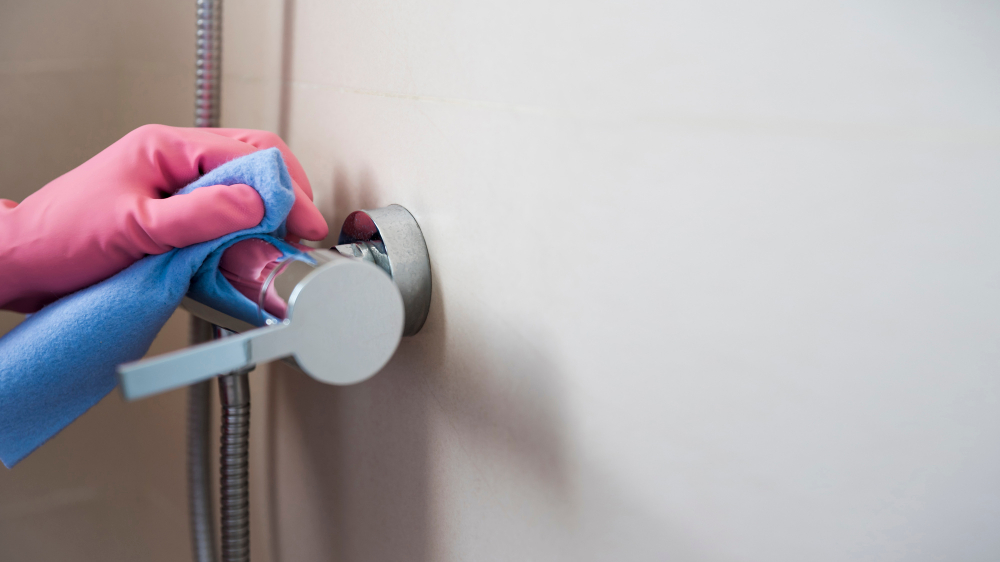
Chrome and brushed-nickel fittings need particular care. Strong acids strip protective coatings when technicians apply them without proper dilution controls or leave them too long. Our team wraps affected fittings with acid-soaked cloths for a controlled dwell period, flushes the showerhead thoroughly to dislodge internal mineral obstructions, then finishes with a protective chrome polish. Homeowners using pure white vinegar on mild staining often achieve reasonable results. They should, however, avoid undiluted commercial descalers on quality chrome — the resulting finish damage voids warranties and cannot be reversed.
Tiles and Grout
Grout lines tell the story of every lime-heavy shower a Johannesburg bathroom has seen. Our tile and grout scrubbing service combines professional-grade rotating brushes with enzymatic and acid-based cleaners matched to the tile type. Porcelain, ceramic, natural stone, and mosaic each require a different chemical profile. We seal grout lines after cleaning to block future mineral deposits and mould spores simultaneously. DIY cleaning almost never includes this sealing step — which explains why professionally deep-cleaned bathrooms stay clean far longer than those cleaned at home.
Toilet Bowls and Cisterns
Hard water staining is often most dramatic — and most embarrassing — in the toilet. That persistent dark band under the waterline combines iron oxide from pipes, calcium carbonate, and mineral-feeding bacteria. Standard bleach-based cleaners cannot shift it because bleach disinfects organic matter but does not dissolve minerals. An acid-based descaler needs extended contact time with the stain to break the mineral bond. Our team also inspects and cleans the internal ballcock, float, and flush valve inside the cistern. Mineral accumulation corrodes and breaks these components long before most homeowners notice a problem.
Basins and Baths
Enamel, acrylic, and stone-composite surfaces each react differently to descaling agents. Enamel tolerates moderately strong acids briefly. Acrylic is highly sensitive to abrasives and strong solvents. Stone-composite and marble must never meet any acid — the chemical reaction etches the stone itself far worse than the original stain. Knowing which product suits which material is central to the results our team delivers. Household products without this context routinely cause damage that professional cleaning was supposed to prevent.
Pro Tip from Randburg Deep Cleaners: After every shower, squeegee the glass screen and wipe chrome taps with a dry microfibre cloth. This single habit, kept consistently, cuts hard water build-up by up to 80% and stretches the time between professional deep cleans — saving you real money.
DIY Versus Professional Bathroom Deep Cleaning: When to Call in the Experts
Regular DIY bathroom maintenance genuinely matters. Daily surface wipe-downs, weekly descaling of taps and showerheads, and proper ventilation all make a measurable difference. The NHS guidance on maintaining a healthy home confirms that regular surface cleaning reduces both mineral build-up and the bacterial and mould load in wet rooms — with clear benefits for allergy sufferers and young children.
Clear thresholds exist, however, where DIY stops being enough. A shower screen that has not been transparent for six months needs professional attention. A rough, gritty texture around basin taps means scale has hardened beyond what household chemistry can safely remove. A toilet stain that survives repeated bleach treatments will not respond to more bleach — it needs an acid-based descaling intervention. Mould at the base of tiles or along silicone strips has already penetrated below the visible surface, and a surface wipe cannot reach it. Our bathroom mould and mildew treatment service addresses this at the root.
The cost argument for professional cleaning is also straightforward. Scheduling a thorough deep clean every three to six months costs considerably less over five years than replacing shower screens, regrouting tiles, and refitting corroded taps that neglect has destroyed.
Protecting Your Bathroom After a Professional Deep Clean
A professional bathroom deep clean resets the clock. Our goal is to restore your bathroom’s best condition and maximise how long your own maintenance efforts stay effective. After every job in Randburg and Roodepoort, we advise clients on the maintenance routine that suits their specific surfaces, household size, and water conditions.
Daily Habits That Make a Measurable Difference
The squeegee remains the most underrated tool in a Johannesburg homeowner’s bathroom. Running it across the shower screen and tiled walls right after a shower removes mineral-laden water before it evaporates and deposits scale. A dry microfibre cloth on chrome fittings adds another layer of protection. Good ventilation matters just as much — a bathroom that dries quickly between uses gives mould no foothold, keeping surfaces cleaner between professional visits.
Weekly Maintenance Cleaning
A citric acid spray — inexpensive at most hardware stores — applied to taps, showerheads, and the toilet bowl waterline once a week, left for ten minutes, then rinsed, stops stage-one deposits from progressing to stage-two crust. This routine is not a substitute for a deep clean. Done consistently, though, it preserves the results of a professional clean far longer and keeps the bathroom looking good week to week.
Knowing When to Book Your Next Deep Clean
Johannesburg bathrooms with two or more daily users benefit from a professional deep clean every three to four months. Single-occupant bathrooms can stretch to six months when the daily and weekly habits above are maintained. Moving into a new property? A move-in / move-out cleaning service starts you from a genuine clean baseline — rather than the previous occupant’s accumulated mineral deposits and mould.
Why Randburg Deep Cleaners Is the Right Choice for Your Johannesburg Bathroom
Our professional deep cleaning company operates from Roodepoort and Randburg, serving Johannesburg and its northern suburbs exclusively. That local focus gives our teams a real advantage. We understand the water chemistry specific to this region, the tile and fitting types common in Johannesburg homes, and the seasonal patterns — summer humidity spikes and dry winter months — that shape how hard water and mould behave here throughout the year.
Our kitchen and bathroom specialist services run through trained, vetted technicians who use professional-grade equipment and chemistry unavailable over the counter. We never apply a generic protocol to every bathroom we enter. Our team assesses each surface, each stain type, and each client’s priorities before starting. Bathrooms needing mould treatment alongside hard water descaling get both in a single visit. Natural stone tiles requiring acid-free treatment receive exactly that. Johannesburg homeowners deserve this standard of service — and we deliver it consistently.
Your bathroom may need targeted hard water treatment, a full deep clean, or both as part of a wider home service. Browse our complete range of cleaning services, or contact us to discuss your bathroom’s specific needs. Our team covers Randburg, Roodepoort, Northcliff, Linden, Fairland, Bordeaux, Blairgowrie, Northriding, and all surrounding Johannesburg North neighbourhoods.
Recent Posts:
- Deep Cleaning Your Kitchen The Randburg Homeowner’s Complete Guide
- From Blairgowrie to Bromhof: Tailored Spring Cleaning Tips for Different Randburg Homes
- Spring Cleaning Mistakes Randburg Homeowners Make (And How to Avoid Them)
- Why September is the Perfect Time for Spring Cleaning in Randburg
- Spring Cleaning Room-by-Room: A Complete Guide for Randburg Residents