
Steam Cleaning vs Chemical Cleaning for Sandton’s Humid Climate
If you own a home or manage a commercial property in Sandton, you already know that the area’s famously humid summers are not just uncomfortable — they are a direct threat to the cleanliness and hygiene of your interiors. From mould creeping along grout lines to persistent odours embedded in upholstery, Sandton’s climate creates cleaning challenges that go well beyond a simple mop-and-go. The question that many property owners and facilities managers are now asking is a deceptively simple one: when it comes to steam cleaning vs chemical cleaning in Sandton’s humid climate, which method actually delivers superior results?
At Randburg Deep Cleaners, we have worked across Sandton’s suburbs — from Bryanston and Rivonia to Hyde Park and Sandhurst — long enough to know that neither method is universally “better.” The right answer depends on the surface, the type of contamination, and crucially, the ambient humidity conditions at the time of cleaning. In this article, we unpack both approaches in detail so you can make an informed decision for your property.
Understanding Sandton’s Humidity Problem
Sandton sits on Johannesburg’s Highveld plateau at roughly 1,600 metres above sea level, which means it experiences warm, wet summers with afternoon thunderstorms and high relative humidity from October through March. During these months, indoor humidity levels inside poorly ventilated homes and offices can regularly exceed 65–70% — the threshold at which mould and bacterial colonies begin to flourish aggressively on porous surfaces.
This matters enormously in a cleaning context because humidity affects how cleaning agents behave and how long a surface takes to dry after treatment. A surface that remains damp for too long after cleaning becomes a re-colonisation site for the very microorganisms you just removed. Understanding this dynamic is the first step toward choosing the right cleaning method for your property.
Did you know? South African Weather Service data indicates that Sandton’s eastern corridors can experience relative humidity levels above 70% on more than 120 days per year — creating near-ideal conditions for mould growth, dust mite proliferation, and bacterial surface contamination.
What Is Steam Cleaning? How It Works
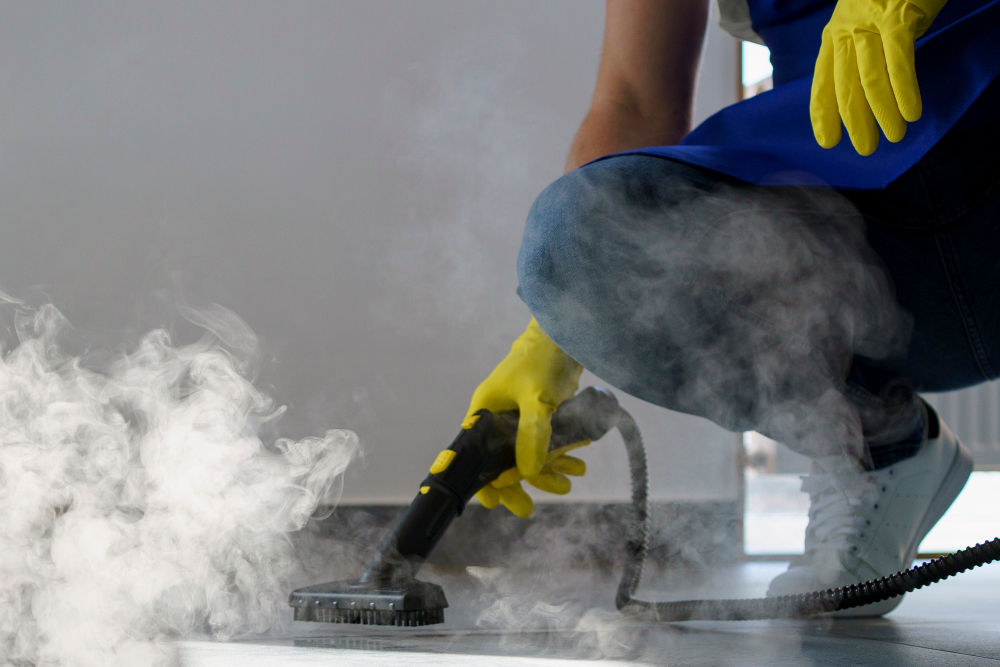
Steam cleaning uses superheated water vapour — typically delivered at temperatures between 100°C and 175°C — to penetrate, loosen, and sanitise surfaces without the use of chemical detergents. The intense heat denatures proteins in bacteria and viruses, effectively killing pathogens on contact. The steam also breaks down grease, dissolves mineral deposits, and lifts embedded dirt from fibres and grout lines.
From a scientific standpoint, steam cleaning is one of the most effective methods for high-temperature surface sanitisation. Research published by the US Centers for Disease Control and Prevention (CDC) affirms that moist heat above 100°C is lethal to a broad spectrum of pathogenic organisms, including the moulds and dust mites that thrive in humid environments like Sandton.
The Advantages of Steam in a Humid Environment
Steam cleaning has a particularly strong case in high-humidity settings for one key reason: it leaves behind no chemical residue that can retain moisture on a surface. Once the steam vapour dissipates, surfaces dry relatively quickly — especially when combined with proper ventilation. For tile and grout in bathrooms and kitchens, where Sandton’s humidity accelerates mould colonisation, steam can reach into porous grout joints and kill the fungal root structure in a way that surface-level scrubbing simply cannot.
Our tile and grout scrubbing service at Randburg Deep Cleaners frequently incorporates steam treatment precisely because it penetrates the micro-surface of grout without the bleach residue that — counterintuitively — can leave a damp, sticky film that attracts new mould growth in humid conditions.
Where Steam Cleaning Has Limitations
Steam is not a universal solution. It can damage or warp certain natural wood finishes, laminate flooring joints, and delicate fabrics not rated for high heat. It also requires a skilled operator — too much moisture applied without adequate dwell time management can actually introduce new dampness into walls or upholstery, worsening the very humidity problem you are trying to address. In a flood or water damage scenario, for example, using steam on an already saturated surface would be entirely counterproductive.
What Is Chemical Cleaning? How It Works
Chemical cleaning encompasses a broad range of methods using purpose-formulated solvents, detergents, disinfectants, degreasers, and biocides to break down soiling, eliminate pathogens, and restore surfaces. Unlike steam, chemical agents do their work through molecular interaction — they emulsify fats, oxidise stains, chelate mineral deposits, or disrupt cell membranes of microorganisms depending on their active compounds.
The scope of what qualifies as “chemical cleaning” is enormous. At the professional end, it includes hospital-grade quaternary ammonium disinfectants used in medical facility disinfection, industrial degreasers used in kitchen degreasing and sanitisation, and enzyme-based treatments used for biohazard remediation. At the consumer end, it includes the spray-and-wipe products most households use daily.
The Advantages of Chemical Cleaning in Sandton
For heavily contaminated surfaces — particularly those with deep grease build-up, entrenched biological soiling, or widespread mould infestations — chemical agents often achieve results that steam alone cannot. Bleach-based fungicides, for instance, are highly effective at killing surface mould on non-porous materials like sealed tiles, glass, and stainless steel. Enzyme-based cleaners are uniquely suited to breaking down organic waste in ways that heat simply cannot replicate, which is why they are indispensable in restaurant sanitation and biohazard cleaning contexts.
The World Health Organization (WHO) recognises certain chemical disinfectants as essential tools for infection control in environments where pathogen loads are high — a category that includes Sandton’s high-density commercial premises and shared residential complexes during the humid summer season.
The Humidity Trap: Chemical Residue in Damp Conditions
Here is where chemistry meets climate in a way that many property owners do not anticipate. Many chemical cleaning agents — particularly ammonia-based cleaners, certain bleach formulations, and alcohol-free disinfectants — leave a hygroscopic residue on treated surfaces. In a humid environment like Sandton in January, that residue attracts and holds airborne moisture, effectively keeping the surface subtly damp long after cleaning is complete. This creates a microenvironment that is actually hospitable to renewed bacterial and mould growth within days of treatment.
This is why professional deep cleaners working in humid climates must be deliberate about product selection, dilution ratios, and post-treatment rinsing protocols. It is one of the many reasons that a bathroom mould and mildew treatment performed by trained professionals will consistently outlast a DIY chemical spray application — proper technique matters as much as the product itself.
Steam vs Chemical Cleaning: The Verdict for Sandton Properties
The honest professional answer is that neither approach operates in isolation at the level of quality deep cleaning. In Sandton’s humid climate, the most effective and durable cleaning outcomes come from an integrated methodology — one that applies steam where heat sanitation and residue-free drying are paramount, and targeted chemical treatment where the depth of soiling or the nature of contamination demands molecular intervention.
For residential properties, our experience shows that steam cleaning consistently outperforms standalone chemical methods on carpets, upholstery, mattresses, bathroom grout, and kitchen tiles — particularly during the humid season. The heat kills dust mites and mould spores without leaving behind any residue that the humid air can later activate. For our carpet and upholstery deep clean service, steam combined with targeted pre-treatment sprays achieves sanitisation results that neither method could deliver independently.
For commercial properties — restaurants, medical facilities, offices, and retail environments — a risk-stratified approach is necessary. High-touch surfaces in food preparation zones require hospital-grade chemical disinfection that steam alone may not sustain across the necessary contact times for certain pathogens. Equally, steam is invaluable in post-disinfection treatment of air ducts and ventilation systems, where chemical residues in circulated air present their own concerns. Our air duct and ventilation cleaning programme addresses exactly this integrated need.
The professional rule of thumb for Sandton properties: Use steam where you need heat-based kill and rapid drying — grout, fabric, soft furnishings, mattresses. Use chemical treatment where you need targeted molecular action — heavy grease, biological contamination, pathogen-critical commercial surfaces. When in doubt, speak to our team at Randburg Deep Cleaners for a property assessment tailored to Sandton’s specific climate conditions.
Practical Guidance by Surface Type
Carpets and Upholstery
In Sandton’s humid climate, carpets and fabric upholstery are among the highest-risk surfaces for mould and dust mite infestations. Steam cleaning at temperatures above 120°C is the superior method for these surfaces during the summer months — it kills dust mites and mould spores while extracting the allergens they leave behind. Chemical shampoo cleaning, while effective for heavy staining, leaves residual moisture in carpet pile that can persist for 12–24 hours in high humidity — long enough for mould to begin re-establishing.
Tile and Grout
Grout is porous and retains moisture, making it the most common site of mould colonisation in Sandton bathrooms. Steam penetrates the grout’s micro-structure and kills fungal root networks; a targeted anti-fungal chemical pre-treatment applied before steaming dramatically extends the period before re-colonisation. This combined approach is at the core of our specialist tile services for Sandton clients.
Kitchen Surfaces and Appliances
Commercial and residential kitchens accumulate polymerised grease that steam alone struggles to break down without extended dwell time. Here, alkaline degreasers perform the essential chemical work of emulsification first, followed by steam or hot-water rinse to remove residue and sanitise. Attempting to steam a heavily greased surface without chemical pre-treatment is both slow and ineffective.
Post-Construction and Renovation Cleaning
After building or renovation work in Sandton properties, chemical cleaning agents are typically required to remove cement residue, adhesive, paint overspray, and silicone sealant — tasks that heat alone cannot accomplish. However, the final sanitisation pass before occupation is best achieved with steam on all fabric and porous surfaces to eliminate construction dust and airborne particulates embedded during the works. Our post-construction cleaning service combines both methods in precisely this sequence.
A note on seasonal timing: If you can schedule a comprehensive deep clean outside of Sandton’s peak humidity window (November through February), surfaces will dry more effectively after both steam and chemical treatment, extending the longevity of results. Our team can advise on the optimal cleaning schedule for your property’s specific layout and ventilation characteristics.
Why Professional Application Makes All the Difference
It bears emphasising that the steam vs chemical debate is largely moot in the context of DIY cleaning. The performance gap between a consumer-grade steam mop and a professional high-pressure steam extraction unit is comparable to the gap between a garden hose and a fire engine. Professional steam equipment delivers consistent temperatures, controlled moisture volumes, and extraction power that handheld consumer devices simply cannot match. The same principle applies to chemical cleaning — the concentration, dwell time, and mechanical action applied by a trained operative produce outcomes that are categorically different from a spray bottle and a cloth.
At Randburg Deep Cleaners, every technician is trained in surface-specific protocols that account for Sandton’s climate. We carry a comprehensive range of both steam and chemical solutions, and our assessments always begin with an evaluation of the ambient conditions — including humidity — before we select our method and chemistry for the day. This is not a luxury consideration; in Sandton’s humid summers, it is the difference between a clean that lasts months and one that needs repeating within weeks.
Whether you need a full house deep clean, a targeted bathroom remediation, or a comprehensive commercial sanitisation programme, our team brings the right tools and the right expertise to every job across Sandton and the broader Johannesburg north area.
Recent Posts:
- How Often Should You Deep Clean Your Carpets? Johannesburg North Homeowners Speak Out
- The Complete Guide to Removing Pet Urine from Carpets in Randburg
- Why Deep Carpet Cleaning is Essential for Sandton Homes During Winter
- Odour Elimination: Getting rid of that “damp” smell after a humid Gauteng summer.
- Sandton Corporate Chic: Why clean office upholstery is vital for making a professional first impression.